
claude-code-driver




Documentation · Getting started · Architecture · API reference · Contributing
Drive the interactive Claude Code TUI (pinned to 2.1.316) from Node.js. The TUI runs inside a private tmux server and you control it with a small typed API: send prompts, answer permission requests, interrupt, change modes, and watch everything Claude does as one stream of events. You keep your subscription login, you get no API billing and no headless -p mode, and the TUI stays fully visible to a human.
import { ClaudeSession } from 'claude-code-driver';

await using session = await ClaudeSession.start({
  cwd: '/path/to/a/trusted/project',
  permissions: (req) => (req.toolName === 'Read' ? { behavior: 'allow' } : { behavior: 'deny', message: 'read-only' }),
});

const turn = session.send('Summarise README.md in one sentence.');
for await (const e of turn) if (e.type === 'text') process.stdout.write(e.data.delta);
const result = await turn.done; // { outcome: 'completed', text, tools, durationMs, ... }
How it works
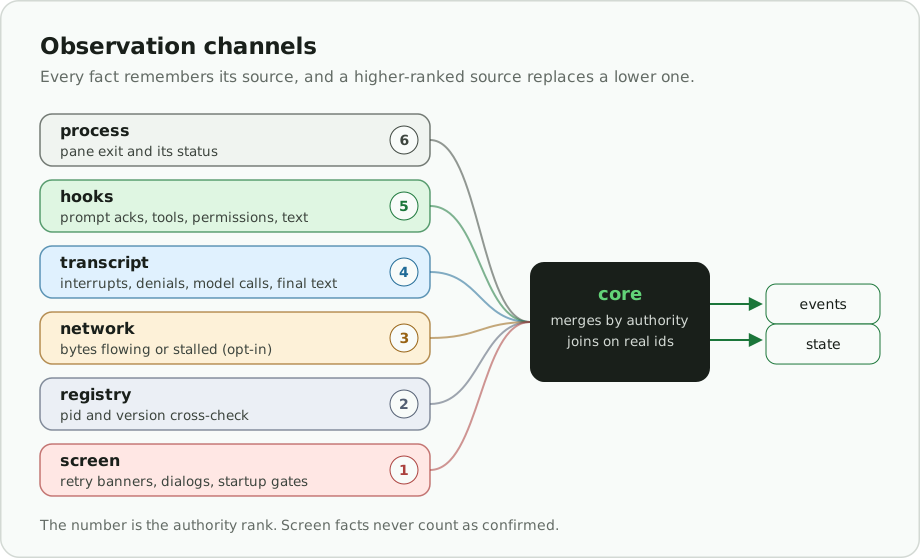
Claude Code is started in a tmux pane on a private socket (tmux -L ccd-<pid>-<hex>). The library observes it through four independent channels and reconciles them into one state machine:
| Channel | What it gives | Source |
|---|---|---|
| hooks | prompt acceptance, tool start/end, permission requests, Stop, SessionStart/End, MessageDisplay text | an injected --settings file whose hooks call a loopback HTTP server (or a unix-socket forwarder), running in a worker thread |
| transcript | the authoritative record: every message, tool result, interrupt marker, turn_duration, API errors | poll + pread tail of ~/.claude/projects/<slug>/<session>.jsonl |
| screen | dialogs, spinners, retry/stall banners, usage-limit lines, the composer | tmux capture-pane, classified by a versioned profile |
| network (opt-in) | per-request timing on api.anthropic.com tunnels | a CONNECT pass-through sidecar (no TLS interception) |
Input never goes through raw keystrokes: prompts are staged through an $EDITOR shim (Ctrl-G), so a prompt is never mistaken for a slash command, bash mode or a paste. Every submission is acknowledged by the UserPromptSubmit hook (or the transcript) before the turn counts as started. A self-test at startup (a blocked nonce prompt) proves the hook round trip works before the session reports ready.
The code is layered (model → platform → channels → core → session → runtime → api/cli). The core is a pure, deterministic reducer, so a recorded session replays byte for byte. See docs/DESIGN.md.
Requirements
- Node.js ≥ 20 (development tooling: Node 22;
.nvmrc) - tmux ≥ 3.2 (tested with 3.5a), on
PATH, in/opt/homebrew/bin,/usr/local/binor/usr/bin - Claude Code 2.1.316 (
@anthropic-ai/claude-code), logged in with a claude.ai subscription (claude auth status→authMethod: claude.ai). API keys and Bedrock/Vertex/gateway providers are refused on purpose. - macOS or Linux.
- A trusted working directory (accepted once in the TUI), or
trust: 'seed', which writes only that one trust key after inspecting the workspace for risky settings.
Install
The package is not on npm yet. Build it from source and add it to your project as a local dependency:
git clone https://github.com/BlitzJB/claude-code-driver.git
cd claude-code-driver && pnpm install && pnpm build      # Node 22 for the tooling (nvm use)
cd /path/to/your/project
pnpm add /path/to/claude-code-driver @anthropic-ai/claude-code@2.1.316
The library looks for claude.exe in this order: the claude.bin option, your project's node_modules, its own node_modules, then PATH. The version must be exactly 2.1.316 (claude.expectVersion: 'any' overrides this, at your own risk).
The essentials
ClaudeSession.start(options)resolves when Claude is ready (SessionStart seen, composer stable, self-test passed). It rejects with aClaudeSessionError(code,details.reason) and tears everything down on any failure.session.send(prompt)returns aTurn.turn.acceptedresolves when Claude acknowledged it, andturn.donealways resolves with aTurnResult. Iterating the turn yields its events. Prompts that start with/are rejected; usesession.command('/clear')for slash commands.permissionsis required:'deny' | 'ask' | 'allowRead' | 'dangerouslyAllowAll'or a handler. A handler that returnsundefinedasks the host through apermissionRequestedevent. Answer it withrespondToPermission, or let the native dialog take over (onTimeout: 'tui').session.usage()returns current subscription usage (session and weekly %, reset times) read from Claude's/usagedialog. It costs no model call.- With
idle: { suspendAfterMs }, an idle session stops Claude and frees the machine. The nextsend()resumes the same conversation first. A pending permission or question always keeps the session live. session.interrupt()sends one Escape (or denies a held permission withinterrupt:true). It never sends Ctrl-C.session.close()waits for background work if you ask, denies held permissions, types/exit, then kills the private tmux server and removes every file it created. If the host process dies, a detached owner-watch kills Claude and the server within 2 s.session.stateis a fullSessionSnapshot,session.statusthe derivedAgentStatus.waitForIdle(),waitForQuiescence()andwaitFor(pred)wait on it.- Every event carries
provenance(confirmedand its sources). Screen-only evidence is neverconfirmed. - Errors are
ClaudeSessionErrorwith one of 18 frozen public codes (E_CONFIG,E_TRUST_REQUIRED,E_TURN_FAILED, …), the internal code indetails.reason, andretryable. Test them withisClaudeSessionError(e, code).
See docs/USAGE.md for the full guide: options, events, statuses, permissions, errors, usage queries and limits, recovery, debugging and live tests.
CLI
ccd lifecheck [--state-dir D] [--json]         reap orphaned sessions, write lifecheck.json (idempotent, < 5 s)
ccd lifecheck install|uninstall|status         a LaunchAgent / systemd timer / cron entry that runs it periodically
ccd view <sessionKey> [--exec]                 the read-only `tmux attach -r` command to watch a session
ccd trace replay|explain <file>                inspect a .ccd.jsonl debug trace
Subpath exports
claude-code-driver: the stable API above.claude-code-driver/kernel(@experimental):createKernel(spec), theSessionKernelport and its types, for writing a different facade. May change in any minor version.claude-code-driver/testing(@experimental): fakes for every port,createTestKernel,replayTrace.
Development
nvm use 22            # dependency-cruiser refuses Node 23
pnpm install
pnpm typecheck && pnpm lint && pnpm test && pnpm build && pnpm check:pkg && pnpm check:api
pnpm test:contract    # real tmux on private sockets, real loopback servers and standalone processes
pnpm test:replay -u   # re-record goldens after an intended behaviour change, then review the diff
node scripts/api-report.mjs --update   # after an intended public API change; review etc/claude-code-driver.api.d.ts
Test projects: unit, arch (layering, timers, .d.ts leaks, option isolation), kernel (scenarios K-01…K-52 against the real session/core/channels with every port faked on a FakeClock), replay (the .ccd.jsonl traces in fixtures/traces, built from the live verification corpus, against fixtures/goldens), contract, and live (gated).
Live tests
The live tests drive the real Claude 2.1.316 with your subscription. CI never runs them.
pnpm build                                                  # L-08 runs the built package in a child process
CCD_LIVE_MAX_PROMPTS=10 pnpm test:live                      # test:live sets CCD_LIVE=1
CCD_LIVE_NIGHTLY=1 CCD_LIVE_MAX_PROMPTS=15 pnpm test:live # adds L-06 (background agent), L-10 and L-11 (network)- Prerequisites: a claude.ai subscription login, tmux on
PATH, the pinned binary innode_modules(node_modules/@anthropic-ai/claude-code/bin/claude.exe --versionprints2.1.316, otherwise every live test skips), and/private/tmptrusted in Claude. Sessions run in fresh directories under/private/tmp/claude-<uid>/ccd-live/<pid>/and inherit that trust. - Every prompt is tiny (
Reply with the word OK.).CCD_LIVE_MAX_PROMPTS(default 10) is a hard budget shared by all live files. A test that would go over it fails instead of sending. CCD_LIVE_TRACE=1writes one.ccd.jsonltrace per session.CCD_LIVE_KEEP=1keeps the run directory afterwards.- The global teardown kills only the tmux servers named in this run's own registry. It never touches another socket.
- Rules for self-hosted runners and the manual sleep/launchd tests are in
docs/MANUAL-TESTS.md.
Status and known limits (v1)
- Only Claude Code 2.1.316 is supported. Screen strings and transcript shapes are pinned in
src/channels/profiles/claude-2.1.316/, and a new Claude version needs a new profile. - Not supported: agent teams, attaching to an existing session, answering MCP elicitations programmatically (they surface as
awaitingInput),/resumeand/rewindinside the pane (usestart({ resume })), live Bash output. - Live-verified on 2026-11-03 (L-01…L-11) and 2026-11-04 (L-14, L-15: idle suspend and resume). They cover start → ready with the cached self-test, a plain turn, resume in a fresh pane, a handler allow and a TUI deny, the
denypolicy, interrupting a running Bash,/clear, a background agent's notification turn, a user proxy, owner SIGKILL → owner-watch cleanup and resume, and one prompt through the network sidecar. L-13 (hook-worker kill) is skipped, and L-11 does not yet test therefusefault. - Usage-limit handling has not met a real limit yet. Under a managed
allowManagedHooksOnlypolicy, the self-test nonce reaches the model beforestart()fails.
Every accepted limitation and every open live-probe question is listed in docs/KNOWN-LIMITATIONS.md.
Contributing
Contributions are welcome. Start with CONTRIBUTING.md and ARCHITECTURE.md; please follow the Code of Conduct. Report security issues privately as described in SECURITY.md. Changes are tracked in CHANGELOG.md.
Disclaimer
This is an independent project. It is not affiliated with, endorsed by or supported by Anthropic. It automates the Claude Code interface you already have access to; you are responsible for using it within the terms of your plan.