
Architecture
This document explains how claude-code-driver works inside: what problem each part solves, how data moves between layers, which rules keep the design honest, and where to make a change. It is written for contributors and for anyone evaluating whether to trust the library.
- User guide: docs/USAGE.md. Normative spec: docs/DESIGN.md (every MUST lives there; this document summarises it and points at code). Change records: docs/icr/.
- Source comments cite design sections as
§n.m, decisions asD-nn, pitfalls asP-AREA-nnand change records asICR nnnn, all indocs/DESIGN.md/docs/icr/. A few comments also cite internal research notes by short tag (RC,TD,SP, …); those notes are not published, andDESIGN.mdcarries every conclusion drawn from them.
1. The problem
Claude Code has two modes:
- Headless (
claude -p, the Agent SDK) streams structured JSON, but it is billed as extra API usage rather than against a Claude subscription. - Interactive (the TUI) uses the subscription, but it is built for a human at a terminal: there is no structured output, no API for "what is the agent doing right now", and input is keystrokes.
claude-code-driver runs the interactive TUI inside a private tmux server and rebuilds a structured, streaming, programmable session on top of it: prompts in, typed events and a live state snapshot out, permissions answered from code, interrupts, usage queries and clean shutdown.
The hard part is not driving the TUI. It is knowing what is true. No single signal tells the whole story:
| Question | Where the truth is |
|---|---|
| Did my prompt arrive? | the UserPromptSubmit hook (live, exact text) |
| Which tool is running, with what input? | PreToolUse/PostToolUse hooks (live, with real tool_use_id) |
| Was the turn interrupted? | only the transcript ([Request interrupted by user]), never a hook |
| Is the model thinking, or is the connection dead? | only network byte flow; the TUI's "thinking" label is time-based and lies during stalls |
| Is Claude retrying an API error, and when? | only the screen (Retrying in 5s · attempt 4/10) |
| Is a permission dialog up that no hook reported? | only the screen |
So the library is built as a multi-source observation system with an explicit trust order, feeding a pure, deterministic reducer that owns all decisions. Everything else is adapters.
2. The big picture
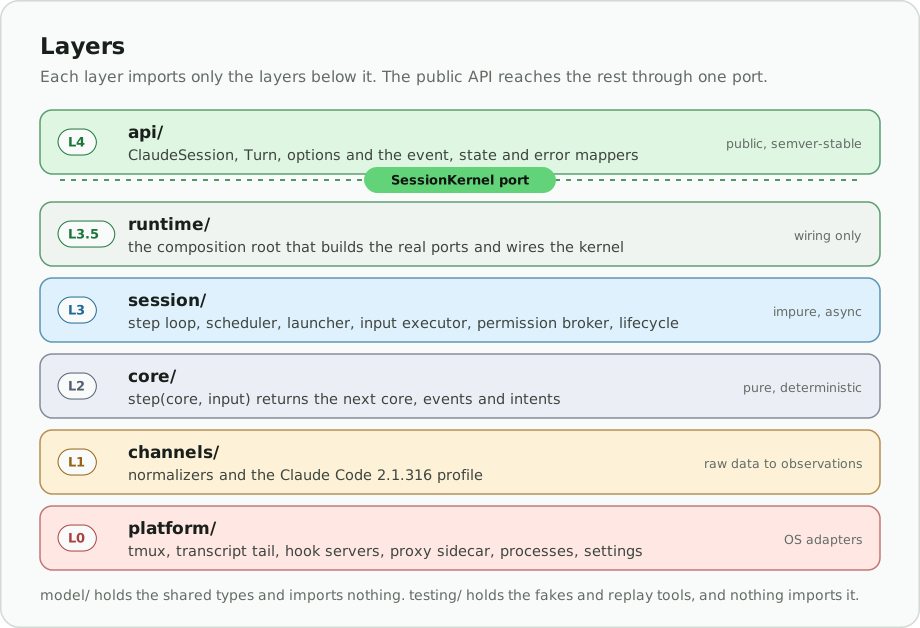
The same picture in text:
                         ┌──────────────────────────────────────────────┐
  your code ── api ────▶ │ L4  api/          ClaudeSession, Turn         │  public, semver-stable
                         └──────────────┬───────────────────────────────┘
                                        │ SessionKernel port (model/kernel.ts) — the ONLY seam
                         ┌──────────────▼───────────────────────────────┐
                         │ L3.5 runtime/     composition root            │  builds real ports, wires L3
                         ├──────────────────────────────────────────────┤
                         │ L3  session/      orchestrator                │  step loop, scheduler, launcher,
                         │                   (impure, async)             │  input executor, permission broker,
                         │                                               │  lifecycle, registry, trace
                         ├───────────────┬──────────────────────────────┤
     commands ─────────▶ │ L2  core/     │  step(core, input) →         │  PURE: no I/O, no clock reads,
     observations ─────▶ │  (pure)       │   {core, events, intents}    │  no randomness, never throws
                         ├───────────────┴──────────────────────────────┤
                         │ L1  channels/     normalizers + profiles      │  raw bytes → semantic observations;
                         │                                               │  all version-specific strings live here
                         ├──────────────────────────────────────────────┤
                         │ L0  platform/     adapters                    │  tmux, fs tail, hook servers, proxy
                         │                                               │  sidecar, processes, settings, clock
                         └──────────────────────────────────────────────┘
                           model/  — shared types, branded ids, errors (imports nothing)
                           testing/ — fakes, replay, scenario DSL (imports anything; nothing imports it)
One cycle of the system:
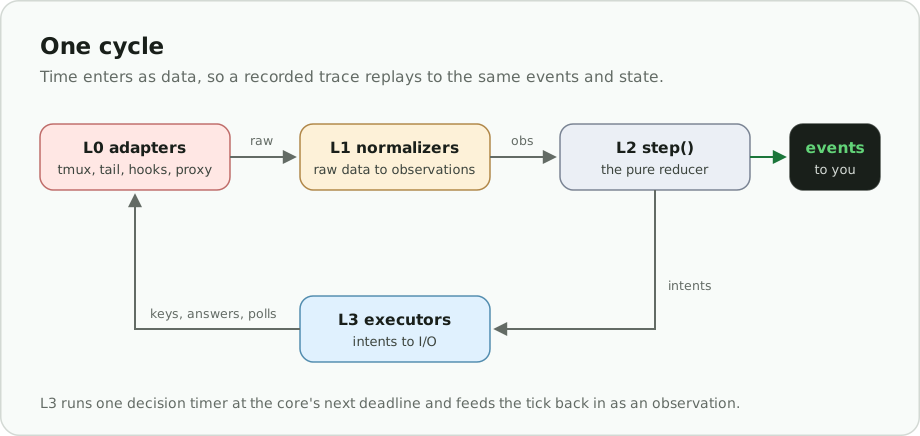
- An L0 adapter sees something (a hook POST, a new transcript line, a screen capture, tunnel bytes, a process exit).
- An L1 normalizer turns it into zero or more observations (
tool.pre,turn.stopped,screen.frame, …). - L3 stamps each observation with a sequence number and time and feeds it, one at a time, into the L2 reducer.
- The reducer returns the new state, domain events to publish, and intents (instructions such as "press Escape", "answer permission p5 with deny", "capture the screen now").
- L3 publishes the events (the facade maps them to public events) and executes the intents through L0, which in turn produces more observations, such as
input.done.
Time enters only as data. The reducer never reads a clock. Every decision timer is a deadline in core state, and L3 runs exactly one timer (at the next deadline) that feeds a clock.tick observation back in. This makes the whole decision layer replayable: a recorded trace of observations reproduces the exact same events and final state.
3. Repository map
src/
  model/      types shared by every layer: ids, time, errors, observations, events, state, commands, intents, kernel port
  platform/   L0 adapters (each with a fake-*.ts next to it)
    tmux/          private tmux server per session: spawn, paste, keys, capture, status (execFile only)
    fs-tail/       transcript follower: poll + pread, byte-level line splitter, file discovery
    hook-server/   loopback HTTP + unix-socket hook servers in a worker thread; standalone command forwarder
    netproxy/      optional CONNECT pass-through sidecar (separate process) + client
    editor/        external-editor prompt injection ($VISUAL + Ctrl-G), standalone editor script
    process/       execFile wrapper, pid identity, owner-watch watchdog (separate process), which(1)
    settings/      Claude's settings layers, ~/.claude.json, trust, workspace inspection
    runtime-dir/   0700 runtime dir (sockets, settings, staging) and state dir (registry)
    clock/ ids/ env/ registry/   real clock, crypto ids, env reader, Claude's own session registry reader
    ports.ts       every L0 port interface (types only)
  channels/   L1 normalizers
    hooks/ transcript/ screen/ network/ registry/
    profiles/claude-2.1.316/   every string, regex and table specific to Claude Code 2.1.316
  core/       L2 pure reducer
    step.ts evolve.ts facts.ts lattice.ts claims.ts deadlines.ts closing.ts selectors.ts keys.ts
    decide/        per-entity decision logic (turns, tools, agents, permissions, model calls, session, usage, …)
    reconcile/     cross-source correlation (permission↔tool binding, spawn links, text matching, network)
    input-policy/  the input job state machine and the text sanitizer
    status/        derived AgentStatus
  session/    L3 orchestrator: kernel, loop, queue, scheduler, launcher, preflight, env/argv/settings builders,
              input executor, permission broker, pollers, tail driver, lifecycle, reaper, registry, redaction, trace
  runtime/    L3.5 composition root (node.ts) and the ./kernel subpath entry
  api/        L4 public facade: ClaudeSession, Turn, options, event/state/error mappers
  cli/        the `ccd` binary: lifecheck, view, trace
  testing/    the ./testing subpath: fakes aggregator, replay, scenario DSL, screen builders, arbitraries
test/
  unit/ arch/ kernel/ replay/ contract/ live/      (see §12)
fixtures/
  traces/ goldens/ screens/ verify/                recorded 2.1.316 behaviour (depersonalized), replay goldens
docs/  DESIGN.md (spec) · USAGE.md (guide) · KNOWN-LIMITATIONS.md · MANUAL-TESTS.md · icr/ (change records)
etc/   claude-code-driver.api.d.ts                 committed public API report (CI fails on drift)
site/  VitePress documentation site (GitHub Pages)
4. Layering
4.1 The dependency rule
Rows may import columns. Enforced by dependency-cruiser (.dependency-cruiser.cjs), per-layer ESLint import rules and arch tests; CI fails on any violation.
| from \ to | model | platform | channels | core | session | runtime | api | cli | testing |
|---|---|---|---|---|---|---|---|---|---|
| model | self | ✗ | ✗ | ✗ | ✗ | ✗ | ✗ | ✗ | ✗ |
| platform | ✓ | self | ✗ | ✗ | ✗ | ✗ | ✗ | ✗ | ✗ |
| platform/*/standalone | node:* only | ✗ | ✗ | ✗ | ✗ | ✗ | ✗ | ✗ | ✗ |
| channels | ✓ | type-only | self | ✗ | ✗ | ✗ | ✗ | ✗ | ✗ |
| core | ✓ | ✗ | ✗ | self | ✗ | ✗ | ✗ | ✗ | ✗ |
| session | ✓ | type-only (ports.ts) | ✓ | ✓ | self | ✗ | ✗ | ✗ | ✗ |
| runtime | ✓ | ✓ | ✓ | ✓ | ✓ | self | ✗ | ✗ | ✗ |
| api | ✓ | ✗ | ✗ | selectors.ts only | ✗ | node.ts only | self | ✗ | ✗ |
| cli | ✓ | ✗ | ✗ | ✗ | reaper.ts, registry-store.ts | ✓ | ✓ | self | ✗ |
| testing | ✓ | ✓ | ✓ | ✓ | ✓ | ✓ | ✓ | ✓ | self |
Additional rules:
core/andmodel/import nonode:*module and no npm package. The core additionally may not useDate, timers,performance,process,console,crypto,Math.random,awaitorthrow(ESLint).- No dependency cycles (runtime edges).
- Nothing in
src/outsidetesting/importstesting/**or anyfake-*.ts. api/imports no npm dependency (the package has zero runtime dependencies).- Standalone scripts (
forward,editor,sidecar,owner-watch) and the hook worker import onlynode:*, because they run as separate processes/threads fromdist/by absolute path. - No internal type (
SessionState,Observation,DomainEvent,Fact<…>,Tmux*,ScreenSnapshot, …) may appear in the public.d.ts;scripts/api-report.mjsgreps for them.
4.2 Why the layers are cut this way
| Layer | Owns | Never does |
|---|---|---|
| L0 platform | talking to the OS, tmux, files, sockets, processes | interpret what it saw |
| L1 channels | turning one source's raw data into semantic observations; version-specific strings | decide anything across sources |
| L2 core | every decision: state, reconciliation, timeouts, input policy, permission policy | I/O, time, randomness |
| L3 session | running the loop, timers, executing intents, lifecycle, launching | make a decision the core should make |
| L3.5 runtime | constructing real ports and wiring them | logic |
| L4 api | the public shape: names, option grouping, event and error mapping | reach below the kernel port |
The split that matters most is L2 vs L3. Because the core is pure, every race the library has ever had is reproducible as a deterministic test: the same observations in the same order always produce the same events.
4.3 Changing the public API
The application-level API is deliberately thin and replaceable:
api/talks to everything below it through theSessionKernelport (model/kernel.ts):dispatch(command),subscribe(listener),getState(),waitFor(pred),setPermissionHandler(h),queryUsage(),close(), plus read-only diagnostics.- Public types are owned by the facade (
api/public-types.ts) and mapped from domain types by exhaustiveswitchstatements (map-events.ts,map-state.ts,map-errors.ts), so renaming a public field never touches the core. - Public option shapes live only in
api/options.ts;toSessionSpec()maps them to the internalSessionSpec. An arch test fails if any file outsideapi/references a property name that exists only in the public options. test/arch/kernel-only-facade.tsdrives real scenarios through the kernel port alone, proving that a different facade (callbacks, RxJS, an MCP or HTTP server) needs nothing else.src/facades/*names are reserved for that.
To build another facade: depend on model/* types, core/selectors.ts and runtime/node.ts's createKernel, and nothing else. The ./kernel subpath exports exactly that set (marked @experimental).
5. Observation channels
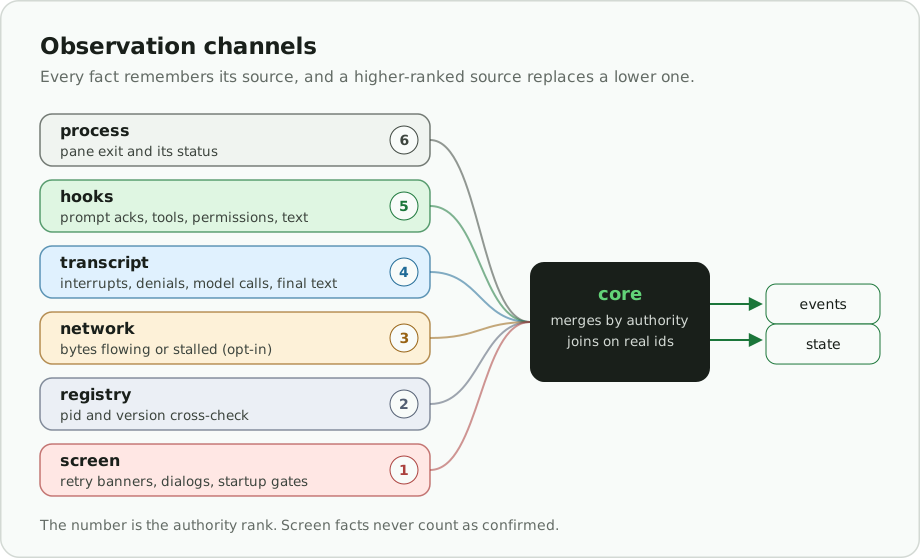
Each channel has one L0 adapter, one L1 normalizer, and a fixed place in the authority order (core/facts.ts, higher wins):
process (6) > hook (5) > transcript (4) > network (3) > registry (2) > screen (1) > self / clock (0)A value from a higher-ranked source replaces a lower one; a lower-ranked source that disagrees is kept as the old value and counted as a conflict (sustained conflicts are a parser-drift signal). Screen-derived facts are provisional claims that are never reported as confirmed.
5.1 Hooks (primary, live)
- Injection. Every session writes its own settings file (0600, in a 0700 runtime dir) and passes it with
--settings. It registers the observation hooks astype: "http"hooks tohttp://127.0.0.1:<port>/h/<sid>/<Event>with a per-sessionX-CCD-Tokenheader, plus a small command forwarder over a unix socket forSessionStart(HTTP is not supported for it) andPermissionRequest(so another local process cannot squat the port and answer permissions). - Worker thread. Both servers run in a
worker_threadsworker so a stalled host event loop never delays Claude's hook calls. Observation hooks get a constant empty200as soon as the body is received; onlyPermissionRequestis held open. - Fail-safe. If the hook worker dies, the session is killed rather than left running with unanswerable hooks.
- What it gives. Prompt acks with exact text and
prompt_id;Pre/PostToolUsewith realtool_use_id, input, response and duration; subagent start/stop withagent_id; permission requests (answerable from code);MessageDisplaytext chunks;Stop/StopFailure; notifications; compaction; model switches. - What it does not give. Interrupts, denials by keyboard, model-call health, retries.
- Code:
platform/hook-server/*,channels/hooks/normalize.ts,session/settings-plan.ts.
5.2 Transcript (authoritative content, near-live)
- Claude writes
~/.claude/projects/<slug>/<session-id>.jsonl. The library launches with--session-id, so the path is known up front, and takes the authoritative path from hook payloads. - Tailing is poll +
pread(250 ms idle, 50 ms during bursts) with a byte-level line splitter that tolerates partial lines, oversized lines (bounded discard mode) and files that do not exist yet.fs.watchis not used. - Generations.
/clearstarts a new Claude session id and transcript file; the library tracks generations (g1,g2, …) without re-keying anything. - What it gives. Interrupt markers, keyboard denials, thinking blocks, final text, per-model-call
api-requestentries (including retries), turn durations, queued-prompt operations, cost state, subagent transcripts. - Code:
platform/fs-tail/*,channels/transcript/*,session/tail-driver.ts.
5.3 Screen (narrow, provisional)
tmux capture-paneon a fixed 250×80 pane, classic inline renderer pinned (alternate screen disabled; every capture asserts it).- The classifier (
channels/screen/classify.ts) finds structural regions (the composer between two horizontal rules, the footer, the spinner line above the composer, dialogs) and produces profile-freeScreenFacts: surface kind (main,permissionDialog,trustDialog,usageLimitMenu,modal,unknownModal, …), status line kind (spinner,retrying,stalled,done,interrupted, …), composer state, footer mode. - The core turns facts into claims with a lifecycle:
candidate → asserted → confirmed | retracted | expired, with stability and TTL, so a torn or transient frame never flips state. - Sole source for: retry banners and attempt counts, the "Waiting for API response" stall banner, permission dialogs that no hook reported (adoption), unknown modals, startup gates.
- Polling cadence is decided by the core (a
poll.cadenceintent): fast while a model call is open or input is being delivered, slow when idle. - Code:
channels/screen/*,channels/profiles/claude-2.1.316/screen.ts,session/pollers.ts.
5.4 Network (optional liveness)
- When enabled, a detached sidecar process runs a CONNECT pass-through proxy; Claude gets
HTTPS_PROXYpointing at it (with a per-session token in the userinfo). TLS stays end to end; the sidecar only meters bytes per tunnel. - It gives the only real liveness signal during a model call: bytes flowing (streaming), tunnel open but quiet (waiting), quiet beyond
stallMs(stalled). - It is off automatically if the user already has any proxy variable (no upstream chaining in v1).
- The same sidecar supports fault injection (
refuse,blackhole,reset,stall,slow) on tunnels toapi.anthropic.comonly, which is how retry and stall behaviour is tested. - Code:
platform/netproxy/*,channels/network/*,core/reconcile/net-correlate.ts.
5.5 Process and registry
pane-diedhook + periodicpane_deadpoll →process.exited(highest authority).- Claude's own session registry (
~/.claude/sessions/<pid>.json) is read once after launch for a pid/version cross-check, and in preflight to refuse resuming an id another Claude still holds.
6. The core (L2)
6.1 Contract
declare function step(
  core: CoreState,
  input: CoreInput,
): { core: CoreState; events: DomainEvent[]; intents: Intent[]; diagnostics: Diagnostic[] };CoreInputis either an observation (withseq,atmonotonic time,wallAt) or a command from the facade.stepis synchronous and total: an internal inconsistency becomes a diagnostic, never an exception.evolve.tsis the only writer of the domain state (lint-enforced); decision code emits core events andevolveapplies them, so state transitions are auditable.
6.2 State model
The domain holds entities keyed by deterministic, session-scoped library keys (t12 turn, u40 tool run, a3 agent, p5 permission, c9 model call, m14 message, j7 input job). Real Claude ids (prompt_id, tool_use_id, agent_id, message_id) are attached as aliases when they become known, so consumers never see a key change when a provisional entity is confirmed.
| Entity | Lifecycle (monotone lattice) | Main sources |
|---|---|---|
| Turn | queued → submitting → running → stopping → completed / failed / interrupted / withdrawn / notSubmitted / aborted / unknown | UPS hook, Stop/StopFailure, transcript |
| ToolRun | proposed → pending → awaitingPermission → running / launched → succeeded / failed / denied / interrupted / unknown | Pre/PostToolUse, transcript tool_result |
| Agent (subagent) | running → stopped / unknown | SubagentStart/Stop, task notifications |
| Permission | pending → answered / dialogOnly → resolved / abandoned | PermissionRequest hook, screen adoption, transcript decisions |
| ModelCall | started → waiting / streaming / retrying / stalled → ended / aborted / failed / refused / unknown | transcript api-request, network, screen banners |
| UiMessage | deltas → final | MessageDisplay hook, transcript text |
| UsageLimit | none → limited → waking → cleared | StopFailure, notifications, screen |
Every field is a Fact<T> that remembers its source and whether it is confirmed (core/facts.ts). Status fields only move forward along their lattice (core/lattice.ts); a late or duplicate observation can corroborate but never reopen a closed entity.
6.3 Reconciliation
Joins happen on real ids wherever they exist. The hard cases have dedicated modules in core/reconcile/:
- Permission ↔ tool binding.
PermissionRequestcarries notool_use_id. It binds to thePreToolUsethat came before it by tool name, canonical-JSON input equality and agent, and only when exactly one candidate matches. Ambiguous requests are never auto-answered by a policy. - Subagent spawn links.
SubagentStart↔ the spawningAgenttool run; internal "ghost" agents (emptyagent_type) are flagged and kept out of user-facing status. - Text matching.
MessageDisplaychunks ↔ the transcript text block that finalizes them. - Network correlation.
api-requestentries ↔ tunnel byte bursts. - Background agents outlive the turn that spawned them; their completion arrives as a
<task-notification>turn that the core recognises and attributes.
6.4 Deadlines
All decision timers are rows in the deadline table (core/deadlines.ts): startup grace, ready stability, prompt-ack wait, editor consumption, Escape gaps, interrupt confirmation, stop grace, transcript settle, late permission binding, hook gaps, network stall/quiet, claim TTLs, permission policy timeout, dialog adoption, modal effect, and usageWake (the only wall-clock kind). L3 asks nextDeadline(core) after every step and arms one timer.
Rule: a timeout never invents a concrete outcome. When the evidence runs out, an entity becomes unknown, never completed or failed.
6.5 Closing rules
core/closing.ts applies, in order, the rules that keep the state tree consistent: nothing open outlives its container (a turn ending closes its main-thread tools, but not a still-running background agent's), a process exit closes everything, held permissions are released (denied) on close, merged turns end with their host turn.
6.6 Derived status
AgentStatus is never stored; core/status/derive.ts computes it from state, first match wins:
exited → starting → awaitingPermission → awaitingInput → interrupted (brief hold) → authRequired → usageLimited
→ compacting → runningTools → writing → modelRequest{waiting|streaming|retrying|stalled} → idle
6.7 Input policy
core/input-policy/ owns every keystroke decision as an input job state machine that emits primitive intents (editorStage, pasteChunk, key, typeLiteral, captureText, …) and advances on input.done and screen frames:
- Prompt delivery (primary path): the prompt is staged into a file and injected through Claude's external-editor feature (
$VISUAL+Ctrl-G), which is atomic and byte-exact for any length. Fallback: bracketed paste of small chunks throughtmux load-bufferfrom stdin. - Delivery is confirmed, not assumed: the
UserPromptSubmithook must echo the normalized text. A mismatch is a security alert. - Sanitizer (
sanitize.ts): strips control characters, rejects prompts whose trimmed text starts with/(usecommand()), escapes! # ? &prefixes, rejects empty prompts. - Gating (
canSubmit): no input while a dialog, startup gate, unknown modal or dirty composer is on screen. - Commands run allow-listed slash commands, detect their effect, and for modal commands capture the modal text (optionally waiting for a named readiness criterion, e.g.
usageReady), then dismiss it with Escape. - Interrupts are a single Escape (never Ctrl-C), or, when a permission is held, a hook answer of
deny + interrupt.
6.8 Permission policy
Permissions fail closed: a handler that throws, times out or returns something invalid means deny; closing while a request is held means deny. Named policies (deny, ask, allowRead, dangerouslyAllowAll) and custom handlers are supported. Plan approval and questions need explicit answers. The screen fallback may only press Escape unless explicitly allowed.
7. The session layer (L3)
7.1 Kernel and loop
session/kernel.ts implements SessionKernel. Its heart is session/loop.ts: a single serialized step loop. Observations and commands enter one queue (queue.ts), get stamped, and are stepped one at a time. Events go to a ring buffer (event-log.ts) that supports replay from a sequence number; subscribers that fall behind get a gap marker instead of unbounded memory growth.
7.2 Timers
Besides the single decision timer, only a closed list of adapter timers may exist (an arch test greps for any other setTimeout/setInterval):
| Timer | Purpose |
|---|---|
| A-0 scheduler | the one decision timer at nextDeadline, plus host-sleep detection |
| A-1 heartbeat | owners/<pid>.json liveness for the CLI reaper |
| A-3 pane-dead poll | process exit backup |
| A-4 screen poll | at the cadence the core requests |
| A-5 auth poll | login state while auth is required |
| A-6 tail follower | transcript polling |
| A-7 loop-lag monitor | warns when the host event loop stalls (permission answers may be late) |
| A-8 owner-watch / sidecar | separate processes, 1 s |
| A-9 trace flush | debug trace I/O |
None of them decides anything; they only produce observations or housekeeping.
7.3 Start sequence
ClaudeSession.start() (session/launcher.ts, session/preflight.ts) runs these steps; any failure throws a typed error and tears down everything created so far, in reverse order:
- Resolve config (unknown keys and a missing
permissionsoption are errors). - Check Node ≥ 20.
- Create the 0700 runtime dir and check the state dir.
- Build the child environment from an allowlist (
process.envis never spread). - Resolve the Claude binary and verify the pinned version.
- Check the account (onboarded, logged in with a subscription; API keys and other providers are refused).
- Read settings layers: hooks not disabled, no keybinding conflicts, hook transport choice, workspace trust (
requireby default;seedinspects the workspace first), resume-id not held by another Claude. - Start the network sidecar if enabled.
- Start the hook worker and the editor injector.
- Write the settings file exclusively (0600) and validate it against the known key list.
- Write the registry record before spawning, so a crash right after spawn is still reapable.
- Probe tmux (≥ 3.2), create the private server (
-L ccd-<pid>-<hex>,-f /dev/null) and spawn Claude via/usr/bin/env -u TMUX -u TMUX_PANE <claude.exe> …with a fixed pane size andremain-on-exit. - Start tailing the transcript.
- Readiness (decided by the core):
SessionStartplus a stable main screen with an empty composer. - Self-test: a nonce prompt that our
UserPromptSubmithook blocks, proving editor injection, Enter, trust and hook delivery with no model call. Cached per process, Claude version, trust state and transport. session.ready:start()resolves.
7.4 Executors
input-executor.tsruns input primitives against the tmux pane and editor injector (FIFO, with the gaps the core specified) and reportsinput.done.permission-broker.tsmaps held hook requests to permission keys, runs the user's handler with a deadline and anAbortSignal, and answers through the hook.path-resolver.ts,tail-driver.tsandpollers.tsexecute their intents and feed results back as observations.
7.5 Lifecycle, crashes and cleanup
close(): optionally wait for background work, deny held permissions, type/exitwhen idle with a clean composer (else SIGTERM the verified Claude pid), wait for the pane to die, escalate to SIGKILL, then stop the hook worker and sidecar, kill the tmux server and remove every file created. Akillclose escalates a running graceful close.- Owner death fails closed. A per-session
owner-watchprocess polls the owner pid every second; if the host process dies, it kills Claude and the tmux server within about two seconds, so no hook port is ever left unbound while Claude runs. - Reaping. The registry in the state dir records every session;
start()andccd lifecheckreap orphans from crashed owners. Pid identity is checked by start time and command line (macOS reuses pids). - Idle suspend and resume (ICR 0041). The kernel can stop Claude and keep everything else: the step loop, the event log, subscribers and the conversation history. It suspends only when
core/selectors.ts suspendBlockers()is empty (no turn, job, model call, open prompt of any kind, background work, scheduled task, limit, auth or compaction), checked and committed in one synchronous block. While the old launch is stopped its observations are gated off, so its exit never reaches the core assession.exited; the core moves to lifecyclesuspendedinstead. A resume swaps incore/resume.ts resumeCore()(every counter and the history kept, everything per-process reset) and relaunches with--resume, the current mode and model, and the tail checkpoint. A failed resume returns tosuspended. - Usage limits. Claude's built-in auto-continue is disabled; the core owns a wall-clock
usageWakedeadline with jitter and resumes with a configurable prompt.
7.6 Observability
session.debugexposes a read-onlytmux attachcommand, the current screen text and the trace path.- Debug traces (
.ccd.jsonl, DebugRecord v1) record raw inputs and observations; the same format is the replay fixture format. Content is redacted by default (redact.ts: exact secret tokens plus patterns).
8. Version profiles
Everything that depends on the exact Claude Code build (screen strings, regexes, footer labels, dialog shapes, transcript markers, hook event lists, slash-command aliases and allowlists, usage-dialog parsing, error and reset-time formats) lives in src/channels/profiles/claude-2.1.316/. ScreenFacts and observations are profile-free, so the core never sees a version-specific string.
The Claude Code version is pinned (package.json claudeCodeVersion and an exact devDependency). start() refuses any other version unless claude.expectVersion: 'any' is set, which runs without guarantees.
Supporting a new Claude Code version:
- Bump the pinned devDependency and
claudeCodeVersion. - Copy
profiles/claude-2.1.316/toprofiles/claude-<new>/and register it inprofiles/index.ts. - Capture new screens and traces (the live tests record traces;
scripts/fixtures-depersonalize.mjsscrubs them). - Run the classifier and replay tests; fix the profile where strings moved. Sustained source conflicts in traces are the drift signal.
- Run the gated live suite.
9. Security model
- Hook endpoints bind to loopback only, authenticate with a per-session token sent as a header (never in the URL, argv or environment), and the permission path uses a unix socket in a 0700 directory.
- Secrets reach the tmux server through the environment of the client that starts it, never through
-earguments (argv is world-readable). - Runtime files (settings, sockets, staged prompts, editor script) live in a per-session 0700 directory and are removed on close; state files are 0600 in a 0700 state dir.
- Child environment is built from an allowlist;
TMUX/TMUX_PANEare unset so the agent cannot drive its own dialogs through tmux; OSC 52 clipboard writes are disabled on the private server. - Input goes through the sanitizer; delivery is confirmed against the hook ack.
- Permissions fail closed;
allowedHttpHookUrlsis only written when the user already has an allowlist (writing one would block the user's other HTTP hooks);disableAllHooksis never silently overridden. - Workspace trust is never clicked through; seeding it is opt-in and preceded by a workspace inspection.
- Out of scope: malware running as the same user and not descended from Claude; shared single-uid CI runners. See SECURITY.md for reporting.
10. Errors
- Internal errors are
CcdErrorwith a stable internal code (model/errors.ts). The facade maps them toClaudeSessionErrorwith one of 18 frozen public codes (E_CONFIG,E_ENVIRONMENT,E_TRUST_REQUIRED,E_TURN_FAILED,E_USAGE_LIMIT,E_SESSION_EXITED, …); the fine-grained internal code is indetails.reason. Turn.doneandsession.exitednever reject. There is no'error'event.- Every code has a category and a
retryableflag; the internal → public map is total and unit-tested.
11. Data formats
- Trace / fixture (
.ccd.jsonl): a header record (format, version, Claude version, config), thenrawrecords per channel (hook payloads, tail lines, captures, tunnel records) andobs/event/diagrecords. Replay feeds the raw records through the real L1 and L2 code with fake L0 ports. - Goldens (
fixtures/goldens/<name>.events.jsonl,.state.json): the expected events and final state for each trace. Updating them is explicit (CCD_UPDATE_GOLDENS=1/pnpm test:replay -u) and the diff is reviewed like code. - Public API report (
etc/claude-code-driver.api.d.ts): the full public declaration surface;pnpm check:apifails when it drifts.
12. Testing strategy
| Suite | What it proves | Runs |
|---|---|---|
unit | each module in isolation; every L0 adapter runs a shared contract suite against both its fake and the real thing | CI |
arch | layering, standalone imports, timer allowlist, env-spread ban, option isolation, kernel-only facade, .d.ts leaks, table coverage | CI |
kernel | end-to-end scenarios through the real L3 + L2 + L1 with every L0 port faked and a fake clock (createTestKernel) | CI |
replay | recorded 2.1.316 traces reproduce their goldens exactly; property tests over the core | CI |
contract | real tmux (several versions in CI), real hook client, standalone scripts from dist/ | CI |
live | the real pinned Claude Code on a real subscription (CCD_LIVE=1) | manual only |
Principles:
- Determinism first. The pure core plus a fake clock means no test sleeps on real time for decisions.
- Every transition-table row is named in a test title (
§4.4#7);scripts/check-table-coverage.mjsenforces it. - Live behaviour is captured, not imagined. Screen strings and transcript shapes come from recorded sessions; the recordings become fixtures.
- Live tests are frugal. They spend real usage, so they are gated, budgeted and never run in CI.
13. Build and tooling
- TypeScript (strict,
exactOptionalPropertyTypes,noUncheckedIndexedAccess), plaintsc, ESM only,.d.tswith maps, subpath exports (.,./kernel,./testing), zero runtime dependencies. - Node ≥ 20 at runtime; tooling runs on Node 22 (
.nvmrc). - ESLint + typescript-eslint, dependency-cruiser, Prettier, Vitest (projects per suite), fast-check, publint, are-the-types-wrong, knip.
pnpm checkruns everything; see CONTRIBUTING.md.
14. Extension recipes
| I want to… | Touch |
|---|---|
| expose a new fact to users | core decision + model/events.ts (additive) → api/map-events.ts + api/public-types.ts → API report |
| support a new on-screen string | channels/profiles/claude-<v>/screen.ts + a screen fixture + a classifier test |
| react to a new hook event | channels/profiles/claude-<v>/hooks.ts (register) → channels/hooks/normalize.ts (observation) → core/decide/* |
| add a slash-command capability | profiles/.../commands.ts (allowlist) → optionally a CaptureUntil criterion → kernel method → facade |
| add a timer | you probably want a core deadline (core/deadlines.ts), not a timer |
| add a public option | api/options.ts → toSessionSpec() → model/spec.ts → session/config.ts |
| build a different facade | model/*, core/selectors.ts, runtime/node.ts createKernel only |
Non-additive changes to src/model/** and every change of behaviour against docs/DESIGN.md get a change record in docs/icr/NNNN-<slug>.md.
15. Glossary
| Term | Meaning |
|---|---|
| Observation | a semantic fact reported by one channel (tool.pre, turn.stopped, screen.frame, …) |
| Domain event | what the core publishes after a step (turn.started, tool.ended, status.changed, …) |
| Intent | an instruction from the core to L3 (input, permission.answer, poll.cadence, tail.*, …) |
| Fact | a state field with its source and confirmation flag |
| Claim | a provisional, screen-derived fact with stability and TTL |
| Generation | one Claude session id within a library session (changes on /clear) |
| Library key | stable session-scoped id (t12, u40, …) that never changes when real ids arrive |
| Profile | all version-specific strings for one Claude Code build |
| Adoption | taking over a permission dialog seen on screen that no hook reported |
| Self-test | the startup nonce prompt blocked by our own hook, proving input and hooks work without a model call |
| ICR | interface change record (docs/icr/) |